
At a glance
American Paint Horse quick facts
- Origin
- United States
- Height
- Varies by individual and bloodline; confirm the horse’s measured height
- Coat
- Tobiano, overo, tovero and solid Paint-Bred categories across many base colours
- Best known for
- Stock-horse versatility with distinctive white-spotting patterns
The modern Paint registry
APHA records the founding of the American Paint Stock Horse Association in Texas in 1962. Its subsequent development brought pedigree preservation and the promotion of colourful stock-type horses into one breed organisation. The registry remains important because appearance alone cannot establish that a horse is an American Paint Horse.
Pinto describes a coat pattern, while American Paint Horse refers to a breed registry with ancestry requirements. A patterned horse from another breed can be a pinto without qualifying as an APHA Paint. That distinction is especially helpful when searching listings that use Paint, painted or pinto loosely.
Understanding tobiano, overo and tovero
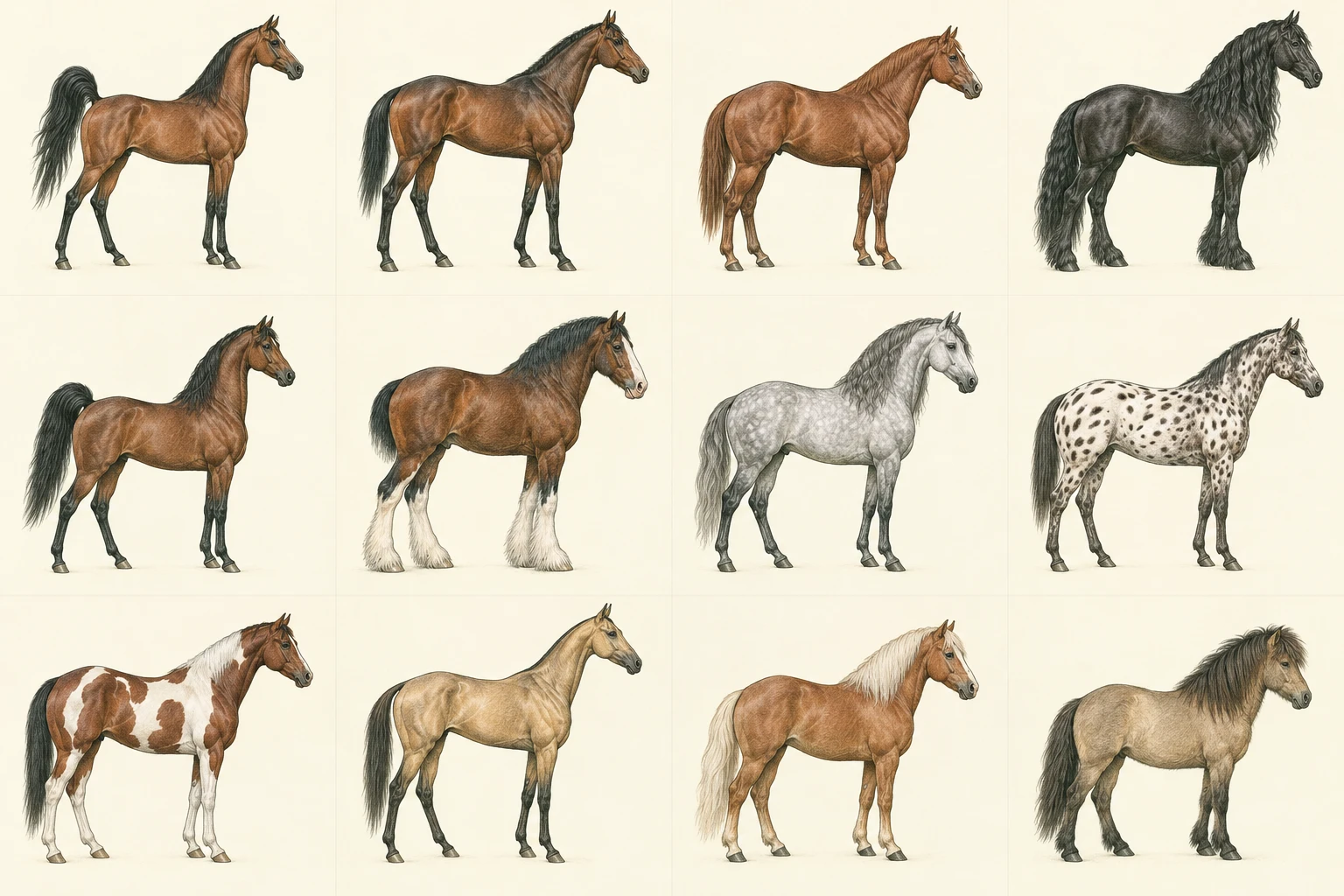
APHA explains tobiano as a specific inherited spotting pattern and uses overo as a broader description of several non-tobiano patterns. Tovero describes a combination involving tobiano and one or more overo-pattern genes. The visible expression can vary, so a neat drawing of one example does not show every possible arrangement of white.
For visual study, separate the underlying base colour from the white pattern layered over it. A bay tobiano and a chestnut tobiano share a pattern category but differ in base colour. Avoid guessing a complete genetic profile from a photograph; the registry's descriptions and relevant test results provide more precise information.
Solid Paint-Bred horses and current rules
APHA recognises Solid Paint-Bred horses and explains routes by which pedigree, Paint traits and pattern genetics can affect registry classification. Its rule book is updated, so a short general article should not be used as a final eligibility decision. Check the current certificate and official rules for the individual horse.
Registration status matters when a buyer hopes to participate in a particular programme or class. Ask exactly which category is shown on the papers and which activities the seller has entered. A horse with limited visible white can be a genuine registered Paint; a brightly patterned horse can still belong to another registry.
Disciplines and individual suitability
APHA describes a wide range of competition and recreational participation. The muscular stock-horse outline is associated with many Western activities, but Paints also appear under English tack and in racing. Each job involves specific training, not simply a change of saddle.
During a trial, ask the seller to demonstrate the skills you need and explain the horse's usual aids. A young performance prospect and an older, established leisure horse may both have attractive patterns but offer very different experiences. Temperament, schooling and daily handling should carry more weight than a preferred arrangement of spots.
Ownership and a useful comparison
Record markings accurately as part of identification and compare them with the registration documents. Ask for age, measured height, recent work and the transfer process. Professional tack fitting still depends on the individual body and head; colour does not determine saddle width or bridle size.
Compare the Paint with the American Quarter Horse and Appaloosa to learn how related stock-horse traditions use different pedigree and colour systems. Treat genetic terminology as a tool for understanding identity rather than as a promise about performance. The right horse is the one whose training and practical needs fit your plans.
Common questions
Is every pinto a Paint Horse?
No. Pinto describes a pattern, while an American Paint Horse must meet APHA pedigree and registration rules.
Can a solid-coloured horse be an American Paint Horse?
Yes. APHA recognises Solid Paint-Bred horses and other qualifying routes under current rules. Check the individual registration category.
What is the difference between tobiano and overo?
Tobiano is a specific inherited pattern. APHA uses overo for a group of other white-spotting patterns, whose appearance and inheritance are not identical.
Sources & further reading
We use breed registries, equestrian organisations and specialist reference sources. Registration rules and training standards can change; check the original source for the latest requirements.
- APHA: history of the association ↗apha.com
- APHA: breed characteristics and patterns ↗apha.com
- APHA: genetics overview ↗apha.com
- APHA: current rule book ↗apha.com
- APHA: registration guides ↗apha.com
Last editorial source check: . General educational information; work with a qualified instructor or veterinary professional for individual advice.