At a glance
Percheron quick facts
- Origin
- Le Perche, France
- Height
- Most are 16.2–17.3 hands in PHAOA’s description; the wider range is 15–19 hands
- Coat
- Usually black or grey; other colours occur in the cited association description
- Best known for
- Draft work, carriage and hitch driving, and a substantial outline with relatively clean legs
Le Perche and a changing working role
The Percheron Horse Association of America places the breed's home in Le Perche, southwest of Paris. Its historical account describes demand for coach horses, followed by urban transport and heavier agricultural work. Breeders adjusted the type as those markets changed, which is more informative than presenting every historical Percheron as an identical giant draft horse.
The association also cautions that very early origins are partly obscured by myth. Use documented studbooks and later records as anchors. The breed's international history includes substantial exports to North America, where it became an important part of farm and freight-horse populations.
Size, colour and conformation
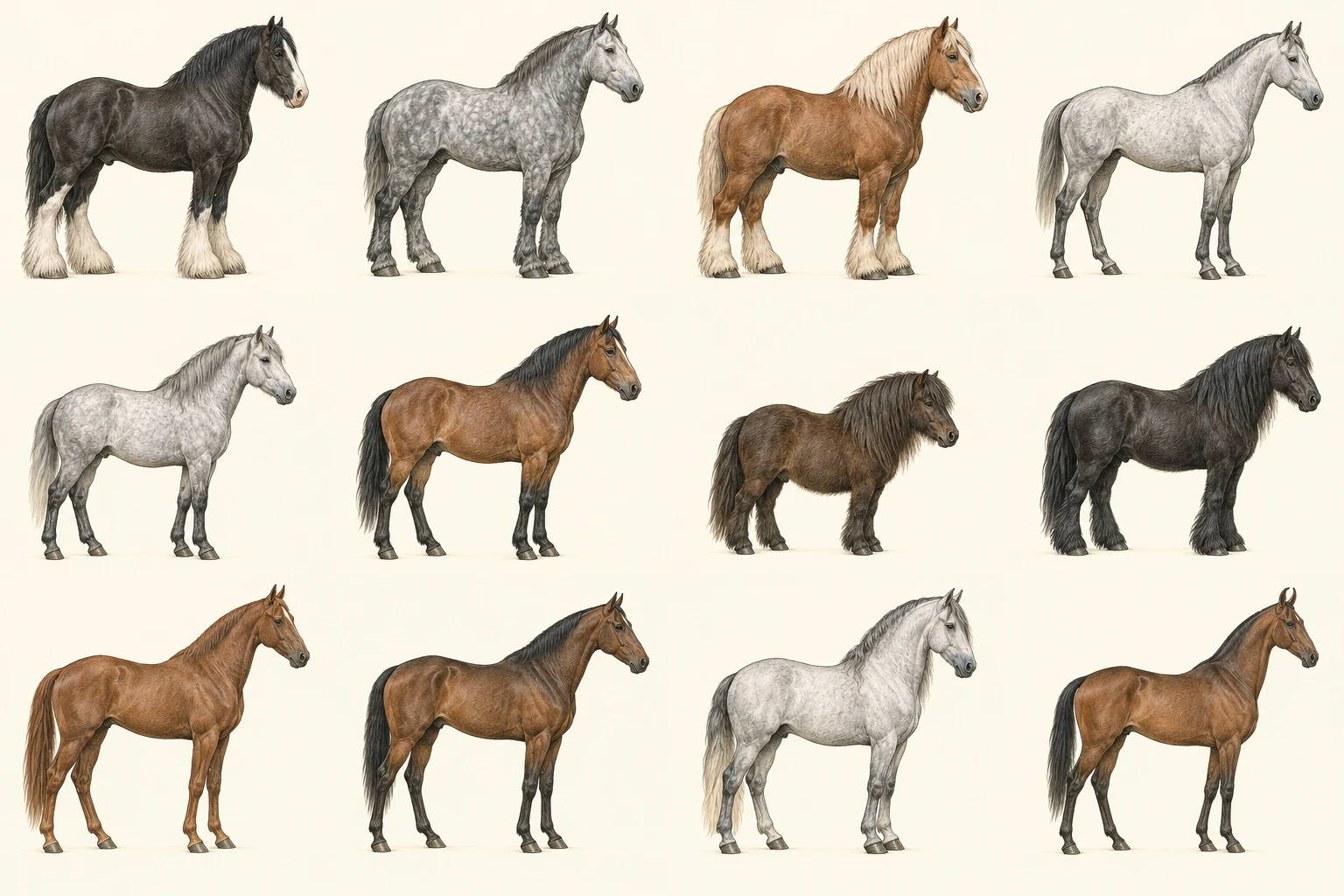
PHAOA describes most Percherons as 16.2 to 17.3 hands, within a broader 15-to-19-hand range. Black and grey are usual, while other colours occur. Compared with heavily feathered draft breeds, the familiar Percheron outline presents the lower legs more clearly.
A grey coat can change appearance over time, so older and younger photographs may look different without showing a different horse. For structural study, compare depth of body, shoulder, quarters and limb alignment. Use measured height and current views rather than inferring scale from a person standing at an unknown distance in a picture.
Modern work and recreation
The association documents hitch competition, halter and riding classes, carriage work, recreation and selective forestry use. These examples show how a draft breed can retain working roles while participating in other activities. They do not mean that every Percheron is already trained for all those jobs.
Ask whether a driving horse knows single work, pairs or larger teams, and which vehicle it normally pulls. Ask whether a riding horse has established mounting manners and basic arena responses. A history of standing in a halter class or travelling to shows tells you something different from ridden or driven education.
Ownership at the horse’s actual scale
A Percheron's broad stated size range makes individual planning particularly important. Measure transport, stable entrances and handling space for the horse being considered. Compare the practical dimensions of harness and saddles with professional advice rather than assuming that any item marked draft will fit.
Routine handling deserves a careful demonstration. Watch leading, standing for grooming and cooperation with foot care. A pleasant breed reputation cannot replace the individual training that makes daily care manageable. Ask the owner how the horse is kept and which professionals are familiar with its needs.
Registration and useful comparisons
PHAOA processes registrations and ownership transfers and publishes the Percheron studbook. Check the particular certificate and transfer procedure if pedigree matters to your purchase. A large black or grey horse may resemble a Percheron without having documented purebred identity.
Compare the Percheron with the Belgian Draft to study two substantial draft outlines and with the Shire or Clydesdale to see the different effect of feather and carriage. Select for your intended work, the horse's demonstrated training and the facilities available. Similar mass does not make every draft breed or individual interchangeable.
Common questions
Where do Percherons come from?
The breed is associated with Le Perche in France. PHAOA describes a long development through coach, transport and draft roles.
Are all Percherons grey?
No. Black and grey are usual in the association’s description, and other colours occur.
How big is a Percheron?
PHAOA gives 16.2–17.3 hands as the common range, while describing a much wider 15–19-hand range. Confirm the individual’s actual height.
Sources & further reading
We use breed registries, equestrian organisations and specialist reference sources. Registration rules and training standards can change; check the original source for the latest requirements.
- PHAOA: origins and history ↗percheronhorse.org
- PHAOA: characteristics ↗percheronhorse.org
- PHAOA: work, recreation and breed information ↗percheronhorse.org
- PHAOA: registry and studbook ↗percheronhorse.org
Last editorial source check: . General educational information; work with a qualified instructor or veterinary professional for individual advice.