
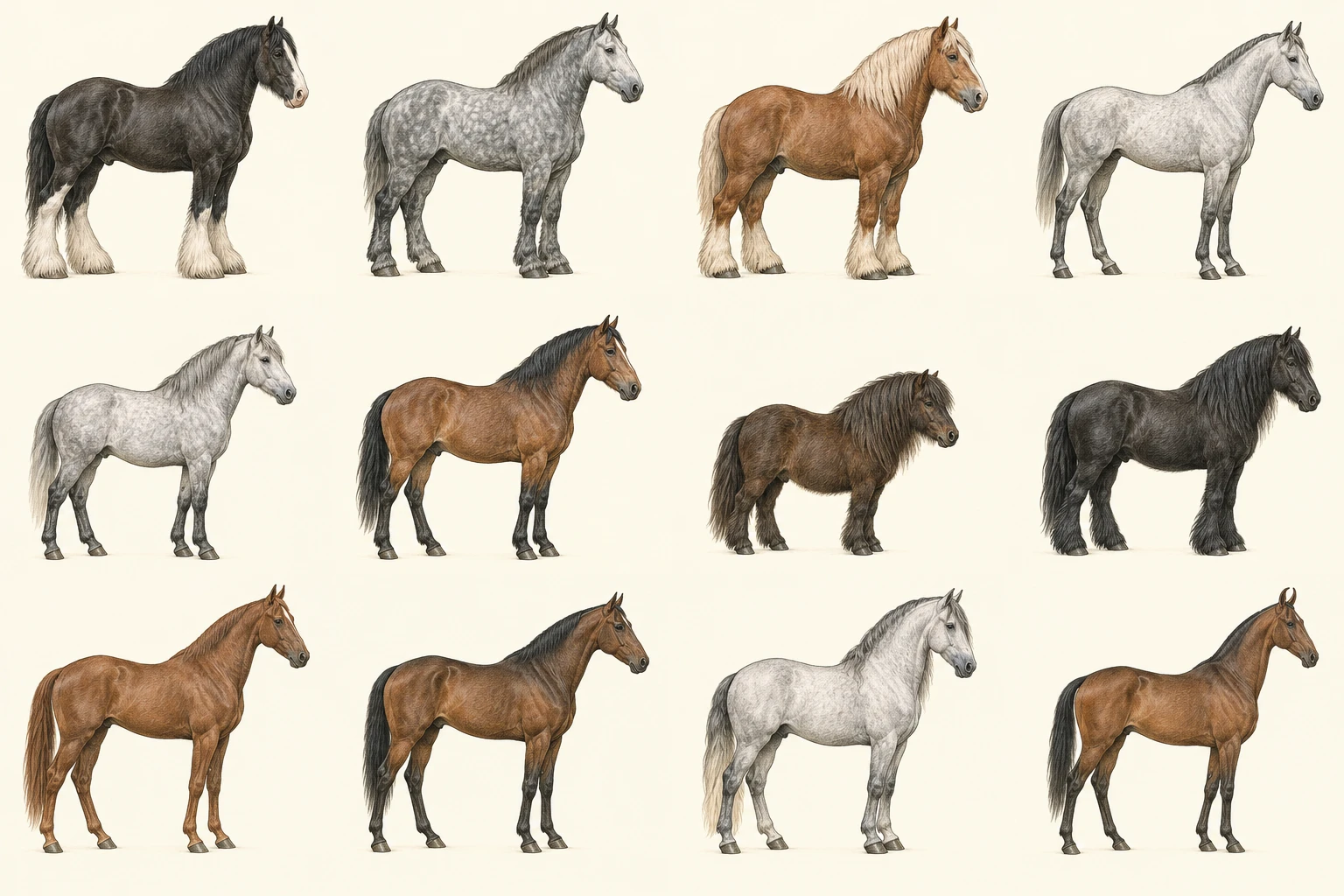
At a glance
Exmoor Pony quick facts
- Origin
- Exmoor, in south-west England, with the Exmoor Pony Society as guardian of the studbook
- Height
- Use the society’s current standard. The pages reviewed here describe type and history rather than a single hand height.
- Coat
- The society’s public pages emphasise a recognisable native type. Read the current standard before treating one marking as the whole breed.
- Best known for
- A free-roaming moorland origin and a studbook guarded since 1921
- Society
- Exmoor Pony Society, guardian of the breed since 1921, charity 1043036
- 1818
- Acland took 30 ponies at the sale of the Royal Forest and founded the Anchor herd
- Conservation list
- Critical on the Livestock Conservancy list reviewed 19 October 2026
Plain language
For kids
- Exmoor ponies are a rare native pony from Exmoor, a high, wet place in south-west England.
- Their society has looked after the breed studbook since 1921. In 1818 a herd that still exists was saved at a sale.
- They are tough. Tough does not mean a child can handle one without a grown-up who knows ponies.
The rest of this page is the longer guide for adults and keen readers.
What the society says it is for
The society’s homepage is direct. Since 1921 it has been the guardian, and it exists to register, preserve and promote the pure-bred Exmoor. It publishes an online studbook, passports and membership, and it is a charity, so donations and legacies are part of how it says the work continues. A pony is an Exmoor in this sense when it is in that book, not when it is merely small, brown and living outdoors.
The ‘what are they like’ page on the same site is a list of warm words: trustworthy, hardworking, hardy, and a versatile pony. Treat the list as the society’s affection, then meet a real pony. Hardy ponies can also be sharp, food-aggressive at a gate, or inexperienced with children.
The history page, used carefully
The society’s history page starts very deep, with a story of wild ponies in Britain long before farms. Some of that page is the society’s interpretation of prehistory. Horsepedia points you to it and does not tighten it into a new date. The written landmarks are easier to repeat without stretching: the page says the first written records of ponies on Exmoor sit with the Domesday survey, when Exmoor was a royal forest, and it says numbers rose and fell in later centuries.
The 1818 sale is the story to remember. The Crown sold the forest to John Knight. Acland’s 30 ponies became the Anchor herd on Winsford Hill. The page says farmers from Withypool and Hawkridge also bought stock and founded herds, and that some of those herd numbers still exist. That is a studbook origin you can visit in words even if you cannot visit the hill.
Rare on a list, alive on a moor
The Livestock Conservancy’s priority list, reviewed on 19 October 2026, placed Exmoor in the critical class. The society’s own job, preservation, is the British side of the same worry. Critical does not mean the ponies on the moor are tame zoo animals. Free-roaming ponies should be watched from a distance and never fed.
Dartmoor, New Forest and Welsh ponies are the neighbours people confuse with an Exmoor. Each has a society. A bay pony with a mealy muzzle is a clue, not a passport. Buy the registration if you are buying the name.
Good doers, and the problem with that compliment
Native ponies that lived on a moor often do well on less feed than a Thoroughbred in work. At home, on modern grass, that becomes a laminitis risk. The body-condition guide is more useful than a sentence about hardiness. A thick winter coat can hide ribs or hide fat. Hands, not the coat, should check.
Feet, worms and teeth still happen on a tough pony. The hoof and dental guides apply. Do not skip them because the breed survived the moor. The moor had its own losses, which is why a society exists.
Ponies for families
The society publishes owning and buying notes and a teachers’ hub, which is a sign that it expects children to learn about the breed. Learning is not the same as being handed the lead rope. A pure-bred Exmoor can be a wonderful child’s pony after education, and it can be the wrong first pony if it has lived as a herd animal.
Ask about handling, not only about bloodline and herd number. Then read the choosing guide. Rare is a reason to be careful with breeding and honest in adverts. It is not a reason to skip a trial.
Common questions
How old is the Exmoor Pony Society?
The society says it has been guardian of the breed since 1921. The ponies’ story on the moor is older than the society.
What happened in 1818?
The society’s history page says the Crown sold the Royal Forest of Exmoor to John Knight, and Sir Thomas Acland took 30 ponies to found the herd now called the Anchor herd on Winsford Hill.
Are Exmoor ponies a good first pony?
Some handled ponies are. A hardy rare breed is not automatically quiet. See the pony, and use a coach who knows native ponies.
Sources & further reading
We use breed registries, equestrian organisations and specialist reference sources. Registration rules and training standards can change; check the original source for the latest requirements.
- Exmoor Pony Society (opens in a new tab)exmoorponysociety.org.uk
- Exmoor Pony Society: history of the Exmoor pony (opens in a new tab)exmoorponysociety.org.uk
- The Livestock Conservancy: conservation priority list (opens in a new tab)livestockconservancy.org
Last editorial source check: . General educational information; work with a qualified instructor or veterinary professional for individual advice.